The Client and the Problem
Rodeo Public Markets operates community food halls that bring dozens of independent food vendors together under one roof. Each hall is a single building with a single landlord, but inside it are many small businesses, each with its own name, its own colors, and its own reason to be noticed. A customer walking the concourse decides where to eat in a few seconds, and the vendor’s sign is the thing that makes that decision.
That creates a problem most sign shops never have to solve. A traditional storefront sign is a one-off: one client, one facade, one permit. A food hall needs the opposite — a system. Every tenant sign has to be creative enough to carry a real brand, consistent enough that the hall still reads as one curated space, buildable on a small-business budget, and installable without shutting down a market that is open seven days a week. Rodeo also has a house style: they love neon, and they want every tenant sign to have neon in it.
Genius Signs is Rodeo’s ongoing tenant signage partner. Rather than bidding each stall as a separate job, we work under a multi-sign agreement that covers the tenant signs across Rodeo 39, Rodeo X, Rodeo River St, and Rodeo 72. New vendors come to us already knowing the format, the landlord already knows what it is approving, and every sign comes out of the same shop in Gardena. Most of the blade signs you see across this website are from that program.
Sign Type and Dimensions
The workhorse of the program is the blade sign: a double-sided cabinet hung perpendicular to the stall from a projecting bracket, so it reads from both directions as customers walk the hall. Inside a food hall the blade sign does the job a storefront sign does on a street. It is the landmark you spot from across the concourse and the thing you point at when you tell a friend where to meet.
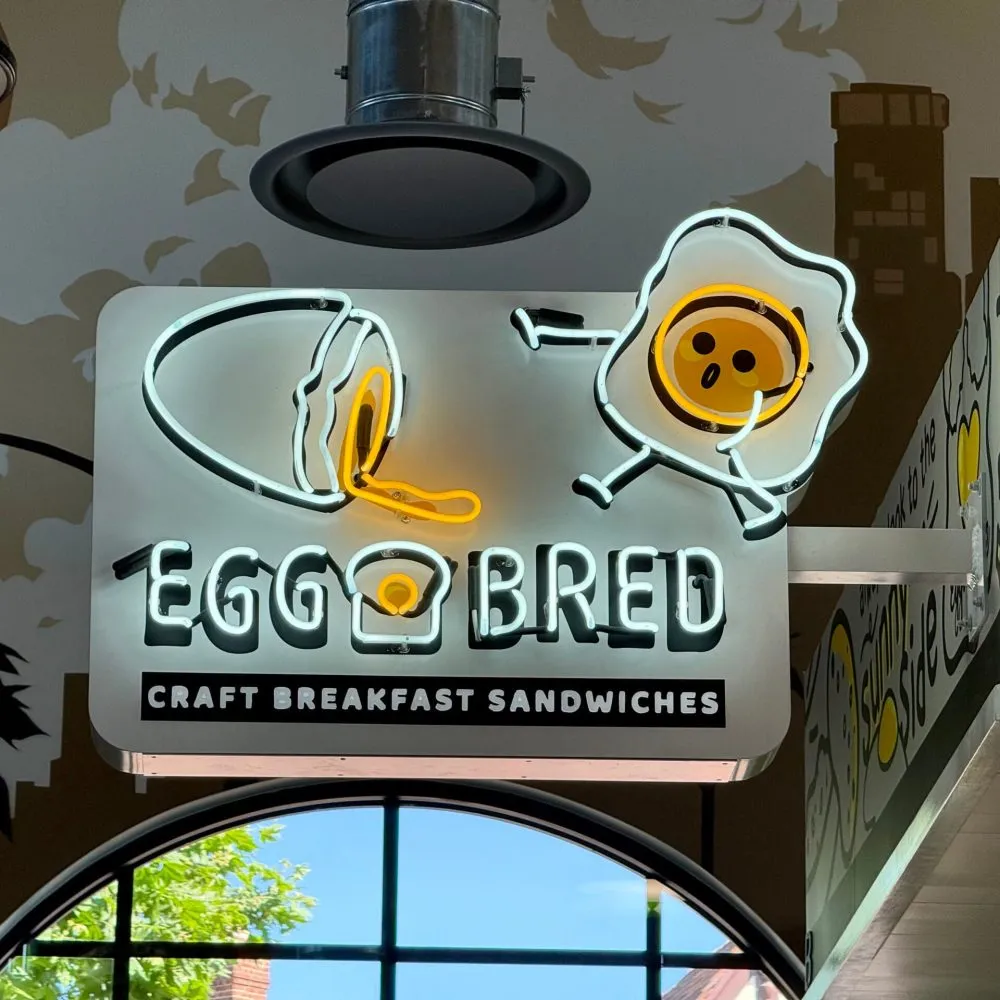
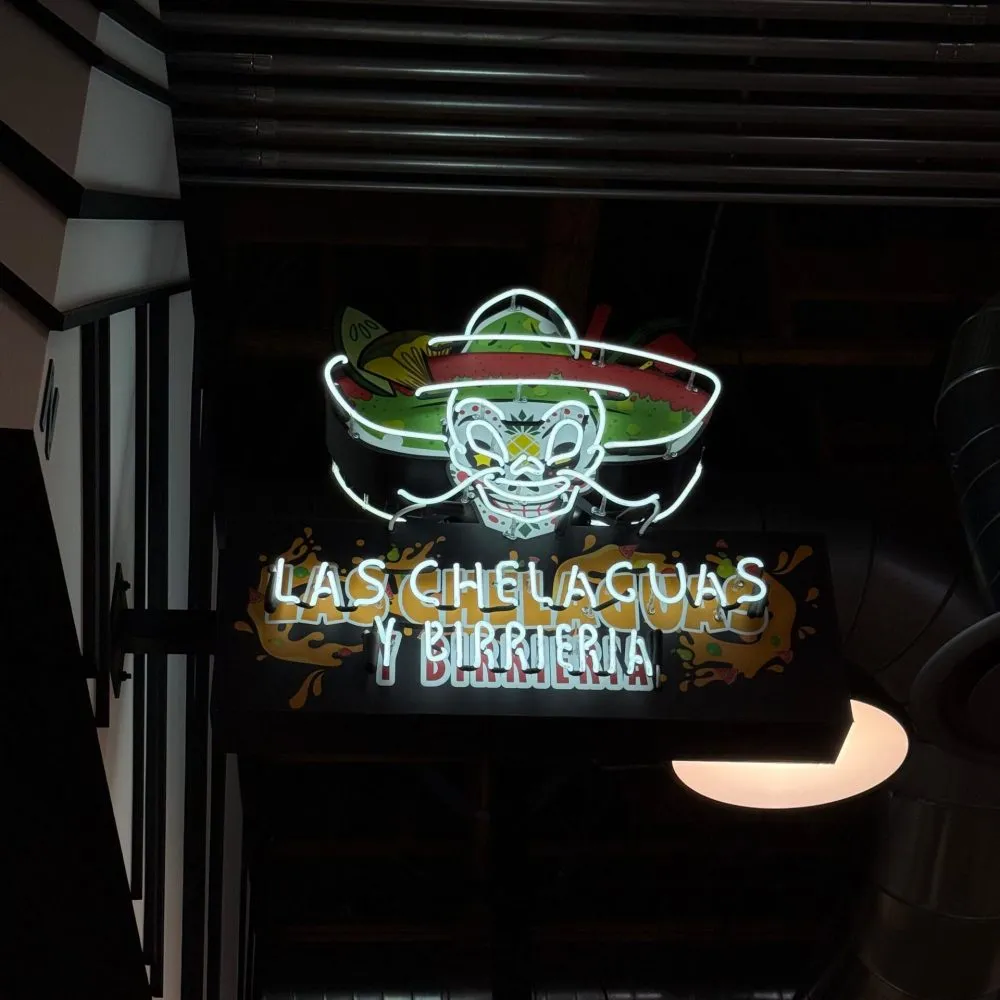
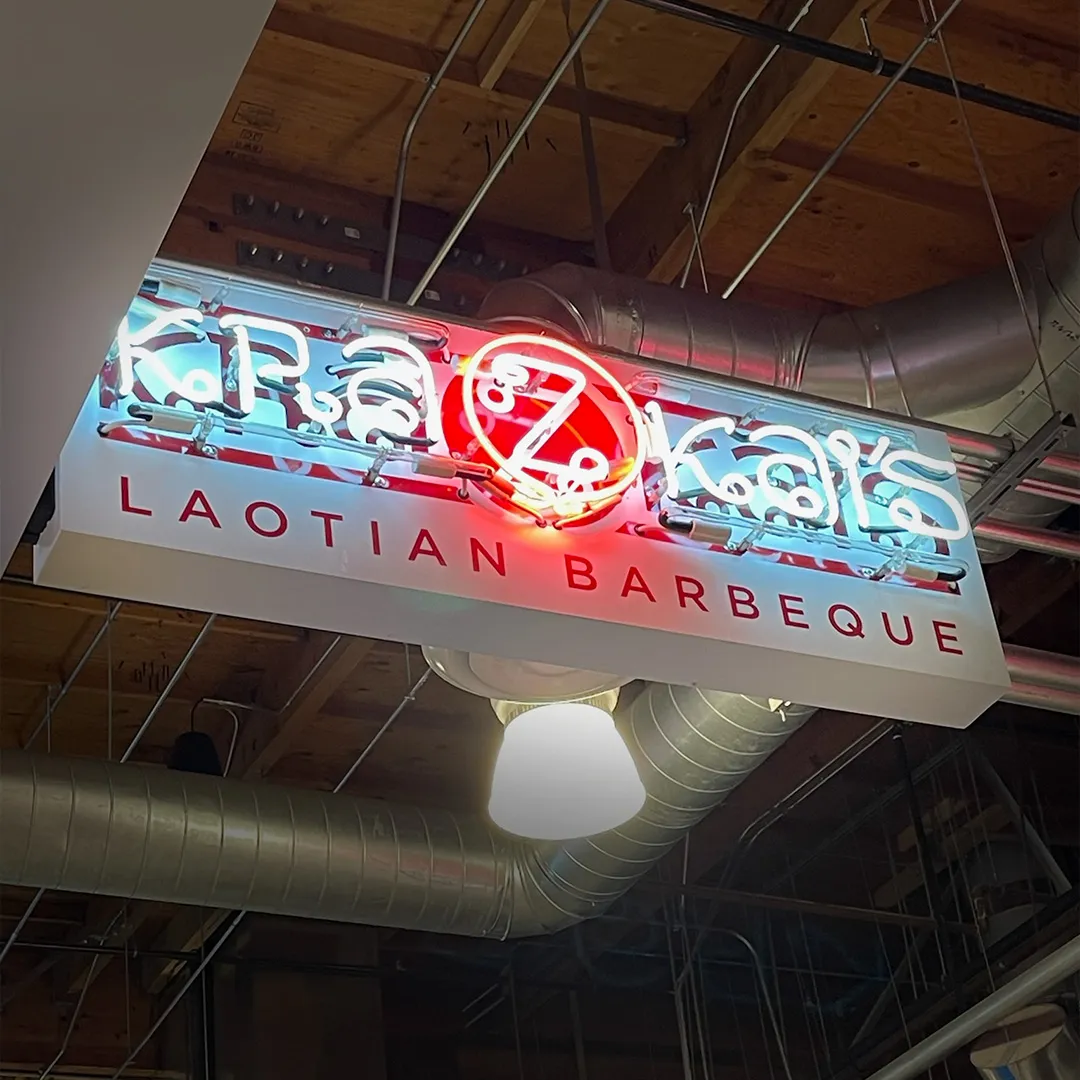
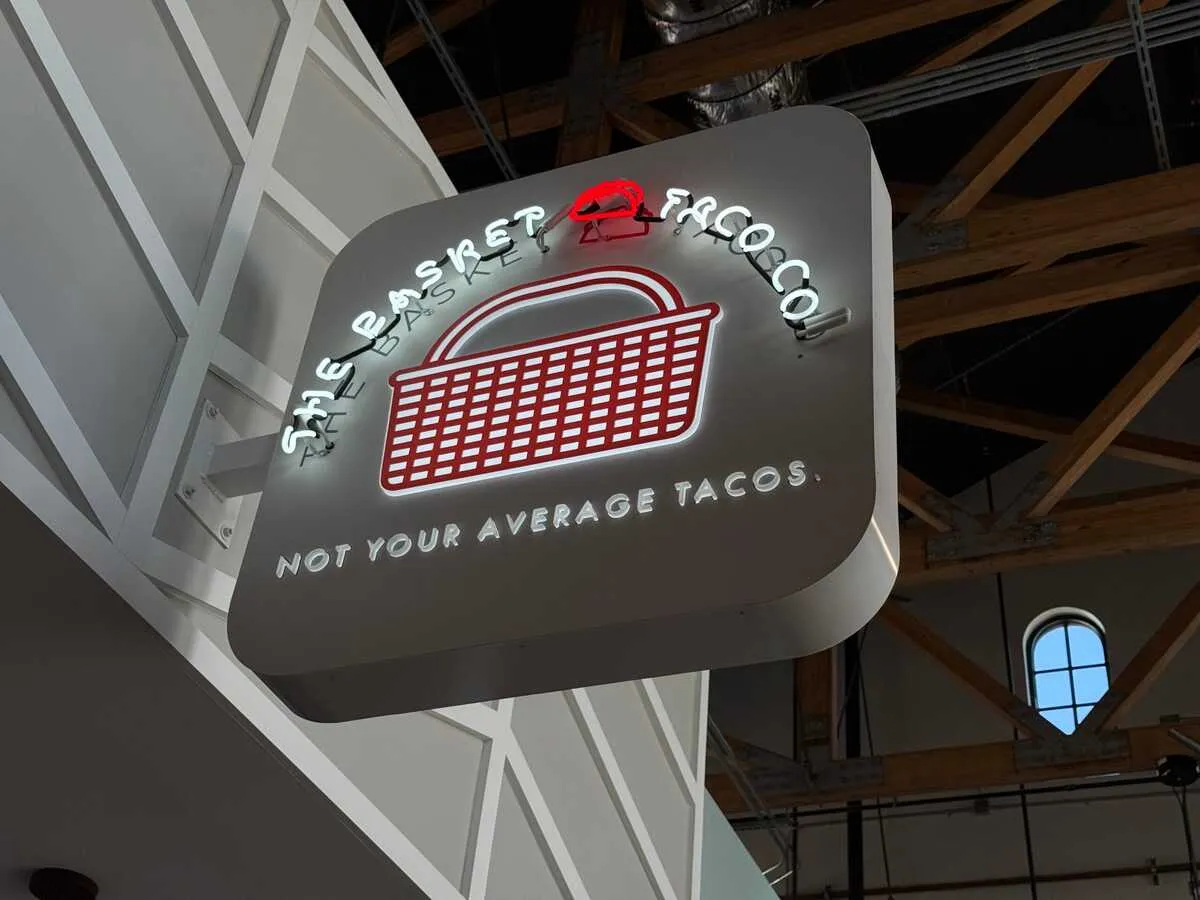
Each tenant cabinet is a different shape. The Basket Taco Co is a wide rectangular panel with its red woven-basket logo, glowing lettering, and the tagline “Not Your Average Tacos.” Egg Bred pairs a “Craft Breakfast Sandwiches” panel with white and yellow neon egg graphics. Las Chelaguas y Birrieria gets a neon-outlined sombrero character over illuminated script. KRA Z KAi’S Laotian Barbeque is a long white cabinet with hand-bent neon script and a red neon “Z” medallion over printed lettering. The shapes vary, but the projection from the wall, the mounting height, and the overall scale stay within a range we set with Rodeo at the start of the program, so no tenant’s sign crowds the next one and the sightlines down the concourse stay clean.
Materials, Neon, and LED Illumination
Every cabinet is welded aluminum, fabricated and painted in our Gardena shop. Aluminum keeps the weight down for a hanging sign, takes paint well, and does not rust in a kitchen environment where there is steam, grease, and daily cleaning. Faces are built to each design — painted aluminum with printed graphics, or translucent faces where the design calls for a lit background — using the same construction we bring to any illuminated cabinet sign.
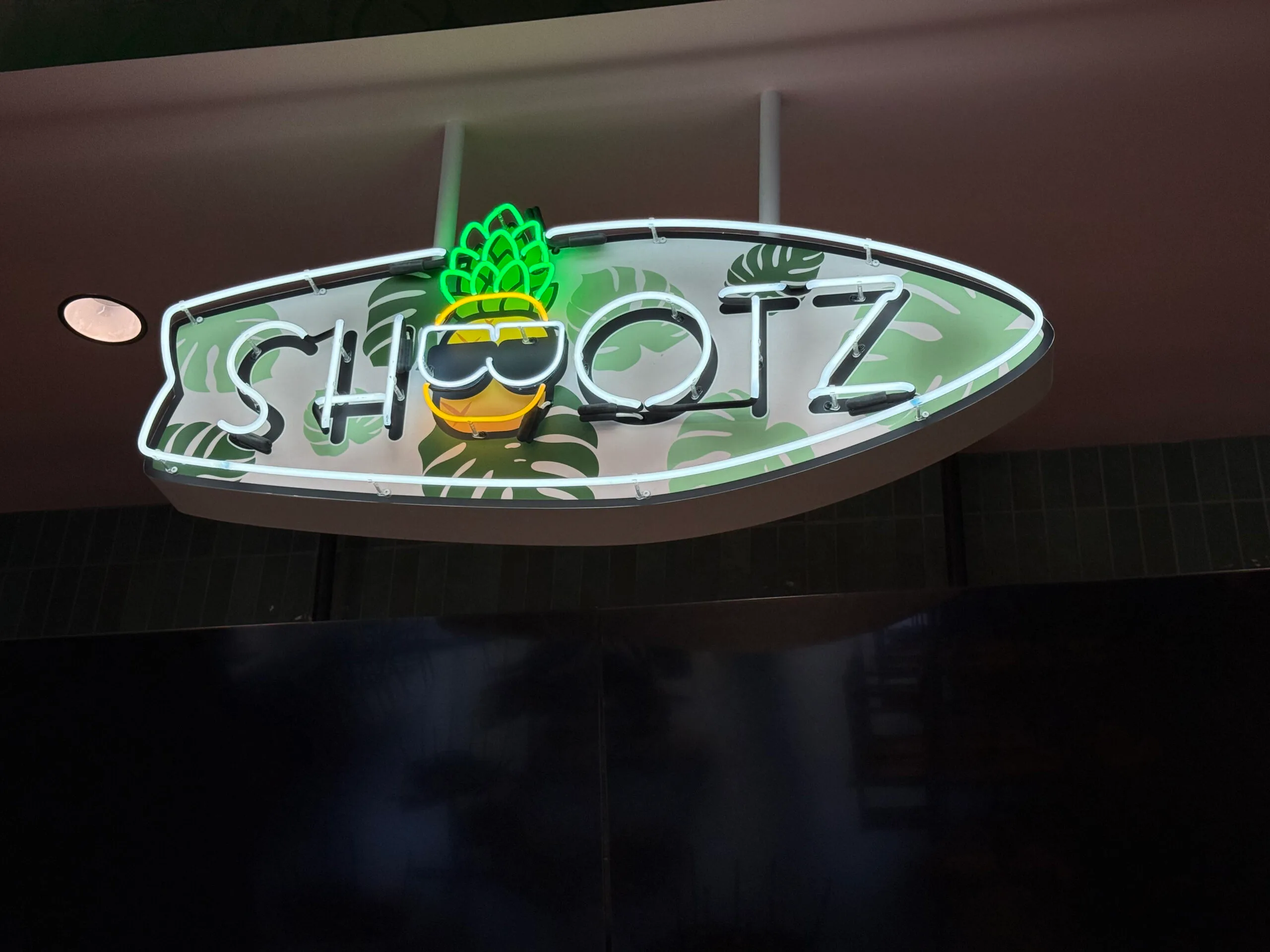
The neon is the signature. Our glass benders bend each tenant’s script and artwork by hand, mount the tubing on the cabinet face with standoffs, and wire it to neon power supplies concealed inside or above the cabinet. Where a design needs a lit face, a halo behind the tubing, or a brighter mark than neon alone can give, we add LED modules inside the cabinet so the neon and LED read as one sign. All electrical components — neon transformers, LED modules, and power supplies — are UL Listed, and the finished signs are built to our own UL listing as an electrical sign manufacturer. The same neon craft goes into our custom neon sign work for stand-alone restaurants.
Interior signs are seen from a few feet away, not from across a parking lot, so the finish standard is different. Every weld is ground, every paint edge is crisp, and every neon bend is checked against the artwork before the cabinet leaves the shop. There is nowhere to hide on a blade sign that hangs at eye level.
Approvals: Landlord, Market, and City
In a multi-tenant venue the approval flow has more steps than a single storefront, and knowing the flow is most of the value we bring. It starts with the tenant: we take their logo and brand assets, translate them into a blade sign design, and produce a rendering that shows the sign on their actual stall. The tenant approves the creative. Then Rodeo approves it against the market’s criteria — neon incorporated, size and projection within the program range, mounting compatible with the hall’s structure. Because we set those criteria with Rodeo at the beginning, tenant designs almost never bounce.
Interior tenant signs in a food hall generally sit under the building’s existing permits rather than needing a fresh city sign permit for each stall, but electrical work is still electrical work. We install under our C-45 electrical sign contractor license, and where a city requires a permit for a specific installation, we handle it. The landlord gets one contractor accountable for every sign in the building instead of a different installer per tenant.
Installation in an Occupied Hall
A food hall does not close for a sign install. Vendors are cooking, customers are eating, and the ceiling above every stall is a working tangle of ductwork, sprinkler lines, conduit, and lighting. Each blade sign hangs from a projecting bracket we anchor into the hall’s structure — the stall framing or the building’s beams, depending on the location — and the bracket has to clear all of that while holding the sign at the program height.
We survey each stall before fabrication so the bracket is built for the actual conditions, not a drawing. Installs are scheduled for off-hours or slow periods, the work zone is contained to the stall, and the sign goes up, gets wired, and gets tested in a single visit. The tenant opens the next day with a lit sign, and the neighbors on either side never lose a lunch service.
Consistency across four locations is the other install challenge. The halls differ in ceiling height, structure, and finish, but a customer who knows Rodeo 39 should recognize the same sign language at Rodeo 72. Building every sign in one shop, to one program, with one crew, is how that consistency holds from market to market.
The Markets
The program spans four Rodeo Public Markets locations: Rodeo 39, Rodeo X, Rodeo River St, and Rodeo 72. Each is a full food hall with its own roster of vendors, and each has grown since it opened, which is why the sign program is ongoing rather than a one-time job. Our shop is at 15204 S Broadway in Gardena, and we serve food halls and restaurant operators across Los Angeles, Orange County, and Riverside County. The same crew that builds the Rodeo tenant signs handles front-lit channel letters for stand-alone restaurants and works with landlords and operators throughout the Los Angeles market.
Results
Every stall in the program has a glowing landmark that customers can spot from anywhere in the hall, day or night. The neon-and-aluminum blade signs give small vendors real storefront presence inside a shared space, and the signs have become part of each market’s character — the thing people photograph and the thing that makes a Rodeo hall look like a Rodeo hall.
For Rodeo, the program delivers what a multi-tenant venue needs from a sign partner: one accountable contractor, a predictable approval flow, consistent scale and quality across every location, and volume pricing that individual vendors could not get on their own. For the tenants, it means a custom neon sign at a price that fits a food-hall budget and an install that does not cost them a day of sales. The partnership keeps growing as Rodeo opens new locations and brings in new vendors, and every new sign comes through the same shop under the same program.
If you operate a food hall, a public market, a shopping center, or any venue with more than one tenant sign, ask us about a multi-sign program. We will set the criteria with you once, and then every tenant that walks in gets a sign that fits.