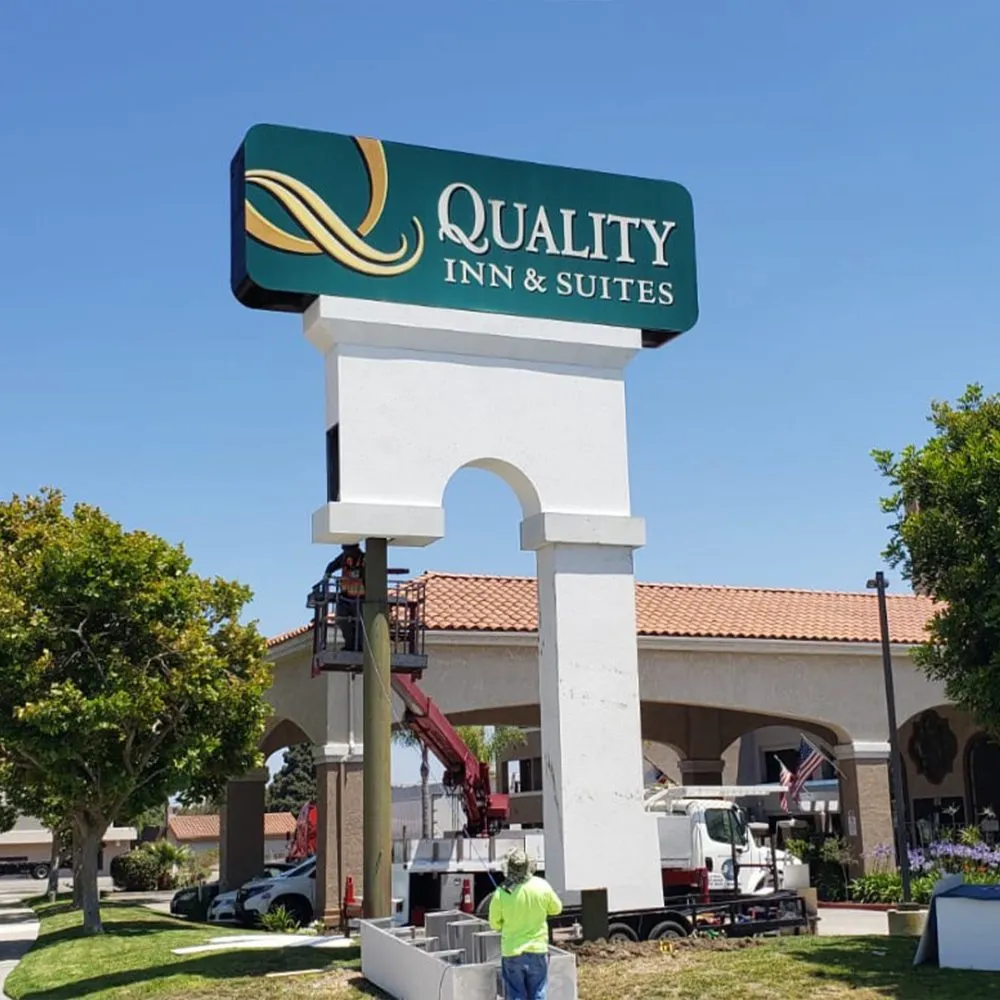
The Client and the Problem
The hotel is a Quality Inn & Suites, part of the Choice Hotels family, on a highway-adjacent site where the pole sign is the first thing a driver sees. When the owners called us, that sign had two problems that are more serious than they look from the road.
First, it was a bare pole. The illuminated cabinet sat on an exposed steel pole with no pole cover, which is not just a cosmetic issue: it makes the sign look like a leftover from a previous tenant and it does nothing to tie the sign to the hotel’s Spanish-style building with its tile roof and arched entrance. Second, and more important, there were no permits on file for the sign. An unpermitted freestanding sign is a liability for a hotel owner. It can hold up a refinance or a sale, it can trigger a code enforcement case, and it can leave the owner exposed if the structure ever fails. The hotel also needed the faces changed to the brand’s current logo.
So the job was really three jobs: legalize the existing sign, make it look like it belongs to the property, and bring the branding up to date — all while the hotel stayed open and guests kept using the driveway underneath it.
Sign Type and Dimensions
The sign is a freestanding pole sign: a single illuminated cabinet on a single steel pole, with the cabinet reading to traffic in both directions. It is the tallest element on the property and the one piece of signage visible from the highway, which is exactly why it needed to be permitted and why it needed to look right.
Our scope kept the existing pole and cabinet in place. Around the pole we designed and built a new architectural pole cover — a wide, arched enclosure with a stepped cap and base that reads as a piece of the hotel’s architecture rather than a sleeve on a pipe. The arch is not a decoration we picked at random: it echoes the arches of the hotel’s porte-cochère directly behind the sign, so the sign and the building read as one design from the road.
Materials and Illumination
The pole cover was built as a framed structure around the existing pole and finished in stucco, painted white to match the hotel’s trim. Stucco was the right call here for the same reason it is on the building: it matches, it weathers well in the South Bay, and it is easy to patch and repaint over the life of the sign. The cover is built to carry its own weight and the wind load on its face without leaning on the sign pole for anything but position.
The cabinet faces were replaced with new faces carrying the current Quality Inn & Suites logo — the green field, gold swash mark, and white lettering. We built the new faces to the cabinet’s existing retainer so the change-out could happen at height in a single lift, the same approach we take on any illuminated cabinet face replacement. The interior lighting was checked and tested as part of the electrical inspection before the sign was re-energized.
Permits and Approvals
This is the part of the project that separates a sign contractor from a sign installer. Because there was no permit history for the sign, we were not simply adding a pole cover — we were legalizing a freestanding sign after the fact. That means drawings of the existing sign as built, a structural review of what was already in the ground, a design for the new pole cover, and a submittal that satisfies both the planning side (is this sign allowed here, at this size, at this height, facing the highway?) and the building side (will the structure stand up?).
Highway-adjacent signage draws extra review. Cities apply tighter standards to freeway-oriented signs, and depending on the site, the state may have its own say about what can be seen from the highway. We built that into the submittal rather than discovering it at the counter. Our permit specialist handled the application, the plan check corrections, the inspections, and the final sign-off. The city approved the sign.
Installation Constraints and How We Solved Them
Building around a live sign. The pole cover had to be constructed in place, around a pole that was staying, under a cabinet that was staying. That meant framing the cover on site, working from a bucket truck for the upper sections and the cap, and keeping the cabinet’s electrical feed protected the entire time.
A working hotel driveway. The sign stands at the hotel entrance with the parking lot and porte-cochère directly behind it. Our bucket truck and crew occupied that space for the duration of the framing and stucco work, so we staged the truck to keep the drive lane open, scheduled the lifts around check-in and check-out, and coned the work zone so guests never had to guess where to walk. The hotel did not close and parking was not shut down.
The face change at height. New faces went in at cabinet height from the bucket, which is why building them to the existing retainer mattered: no field-cutting, no second lift, and no day with a blank cabinet facing the highway.
Stucco, weather, and inspections. A stucco pole cover is built in stages — frame, lath, scratch coat, finish, paint — and each stage has to cure before the next. We sequenced those stages around the required inspections so the inspector saw what needed to be seen at the right moment and the job did not stall waiting on a callback.
The Location
The hotel is in Torrance, in the South Bay, on a site that fronts a highway — a short run from our shop in Gardena. That proximity mattered on a staged job like this one: our crew could return for each stucco coat and each inspection without a long haul, and the hotel had a contractor a few miles away if anything came up afterward. We handle pylon and pole sign projects across the South Bay and Los Angeles County, including the permitting work that older signs so often turn out to need.
Results
The Quality Inn & Suites now has a permitted, city-approved pole sign that looks like it was designed with the building. The white arched pole cover picks up the hotel’s architecture, the new faces carry the current brand logo, and the sign that used to be a bare pole with a cabinet on top is now the property’s best-looking piece of exterior signage from the highway.
Just as important, the paperwork is clean. The owners have a permitted sign on file, a structure that has been reviewed and inspected, and a contractor who will still be here when the next brand refresh comes around. If you own a hotel or commercial property with a sign you inherited and cannot find permits for, this is the process: we document what exists, design what is missing, pull the permits, build it, and get it approved. Read more about how we work with property owners throughout Los Angeles County, or call us for a site visit.