
Digital LED Displays — Programmable Signs That Work 24/7 for Your Brand
Full-color LED displays and electronic message centers that you can reprogram from a laptop. Daily specials, price changes, event schedules, and animated brand content — all on a single sign that pays for itself in promotional flexibility. Indoor and outdoor, small tenant screens to highway-visible monument systems.

What Are Digital Displays?
Arrays of tiny LED pixels inside weatherproof cabinets, driven by a media controller you manage from software. Full motion video, animated graphics, scheduled dayparting, and real-time content updates — and an EMC can work as a stand-alone sign or be built into a monument, pole, or pylon structure.

Anatomy of an LED display
A digital sign is four systems stacked: the visible pixel grid, the cabinet that holds them, the brain that drives them, and the shell that keeps the weather out. We spec and install all four.
-
1
High-resolution LED modules
Dense grids of red/green/blue LEDs in fixed pixel pitches (P3–P10 outdoor, P1.5–P4 indoor). Higher resolution = readable closer up.
-
2
Aluminum cabinet
Modular front-service cabinets. LED boards, power supplies, receiving cards — all field-swappable without pulling the sign down.
-
3
Content controller
Media player + software. Schedule dayparts, upload video, push updates from a laptop or phone. Cloud-based or on-premise options.
-
4
Weatherproof housing
IP65-rated outdoor cabinets with thermostat-controlled ventilation, ambient light sensors, and surge protection built in.
What LED Displays Cost in LA
Case-by-case — we quote firm after a site visit or artwork review.
Pricing is case-by-case. Every LED display project is custom — size, pixel pitch, indoor vs outdoor, content system, mounting — all affect cost. We provide a firm quote after a site visit or artwork review.
Permits are a fixed $1,500 — our flat fee for permit runners, drawings, and city coordination. City fees (plan check, inspection, use permits) are billed at cost with zero markup and paid directly by the client. See Sign Permits for the full policy.
Production itself runs 2–3 weeks once permits are approved; see the timeline below for the full project duration. Complex fabrication may add time; we tell you upfront.
Three Ways to Deploy a Digital Display
An EMC can stand alone as its own sign, or be integrated into a larger monument, pole, or pylon structure — we build new and retrofit displays into existing sign structures. Where the display lives determines the cabinet, the brightness rating, and the structural work.
Indoor Display
Fine pixel pitch (P1.5–P4 indoor) for close-range viewing. Lobby screens, conference rooms, retail back walls, and menu boards. Lower brightness, air-conditioned ambient temperature.
Outdoor Weatherproof
IP65+ cabinets, 5,000–8,000 nit brightness, ambient light sensors, and thermostat-controlled ventilation. The standard for dealerships, gas stations, pharmacies, and church schedules.
Monument Integration
Digital display built into a permanent stone, brick, or architectural monument at your property entrance. Static brand ID above, programmable LED below — the full-service signage system.
Concept to Lit Screen in 4 Steps
Every digital display follows the same proven workflow — engineering, permitting, fabrication, and commissioning.
Design & Spec
Site survey, viewing-distance math, pixel-pitch selection, brightness class, and a rendering showing the display on your actual property.
Permit & Engineering
EMC-specific sign permit, wet-stamped structural drawings, Title 24 energy compliance, and any CUP requirements. LA jurisdictions vary significantly.
Fabrication & Pre-Test
Cabinet build, LED module installation, factory burn-in, controller provisioning, and content-software onboarding — before anything ships to site.
Install & Commission
Structure set, cabinet mount, power + network tie-in, pixel calibration, content upload, and staff training on the CMS — usually 1–2 days.
Six Reasons Programmable Wins
Change Content Anytime
New daily special? Price change? Event schedule? Push it live from a laptop in 30 seconds. Zero reprinting, zero truck-rolls.
Dayparting & Scheduling
Breakfast content 6am–10:30am, lunch content 10:30am–4pm, dinner after that. Schedule weeks in advance, auto-rotate on holidays.
Animated Brand Content
Logos animate, products rotate, video loops play. Motion catches peripheral vision in a way that static signage simply can't.
Auto-Adjusting Brightness
Ambient sensors dim the display at night to avoid glare complaints and ramp it up under direct sunlight. Complies with LA EMC codes automatically.
Multi-Message Rotation
One display, infinite campaigns. Promote three different menu items, two events, and a phone number — all on a 60-second rotation.
Remote Management
Cloud CMS means one operator can manage displays at 1, 5, or 50 locations. Upload once, push to every store, track which messages ran.
Industries That Live on Digital Displays
Auto Dealerships
Daily specials, financing offers, new-model arrivals, service-department promos. The single sign-type category where EMCs are near-mandatory.
Gas Stations & Convenience
Live fuel prices, in-store deals, car-wash promos. Pricing updates throughout the day in response to market changes — zero physical labor.
Churches & Community Centers
Service schedules, event announcements, community messages. One sign replaces the old letterboard and never blows away in the wind.
Schools & Universities
Game schedules, honor roll, closures, enrollment dates. Programmable messaging that covers a school year without a single panel swap.
Event Venues
Concert lineups, sports schedules, sponsor rotations. Venue marketing departments push content directly to entry-facing displays.
QSR & Retail Plazas
Quick-serve restaurants run LTO (limited-time offer) campaigns and retail plazas rotate tenant promos. Daypart pricing, menu changes, combo rotations — all remote.
When Digital Wins — and When It Doesn't
We build every sign type. Here's the honest breakdown of when digital is the right spend and when a different solution delivers more value.
Choose digital displays if Yes
- Your content needs to change daily or weekly.
- You run promotions, dayparts, or time-sensitive offers.
- Your jurisdiction allows EMCs (we'll verify during design).
- You have 2+ locations and want centralized content control.
- Budget $15K+ with a 5–10 year payback horizon.
Consider another option if Maybe not
- Your content never changes — see illuminated cabinet signs.
- You need permanent brand ID only — see monument signs.
- You operate a drive-thru and need menu-specific signage — see drive-thru menu boards.
- You need a facade storefront sign — see channel letters.
- Your city prohibits EMCs — see traditional pylon signs.
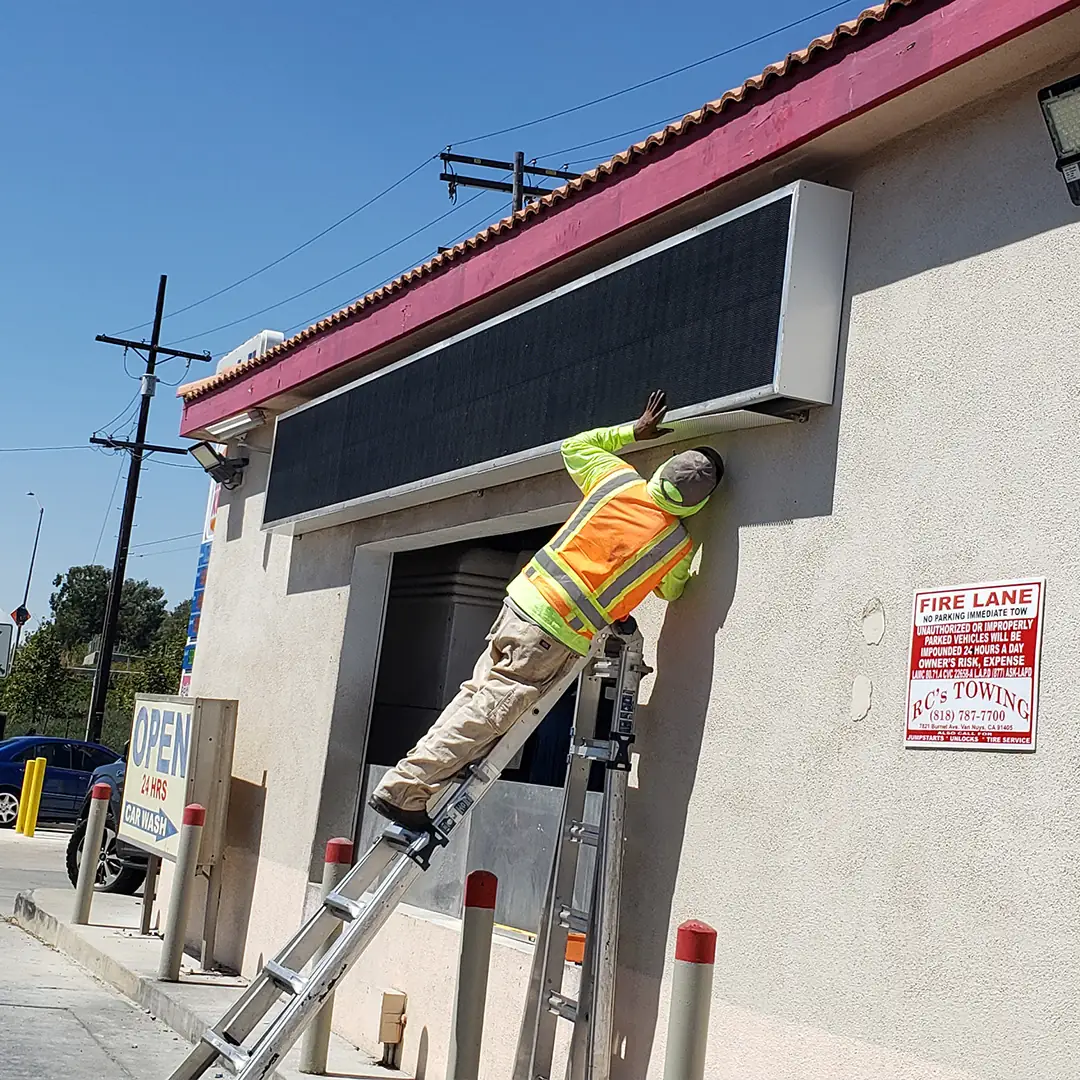
Real EMC Work — Shop, Install, and Design
An LED cabinet in fabrication, an EMC going up on a storefront, and a current monument-integration design — all from our own shop, no stock imagery.
Frequently Asked Questions
What is an electronic message center (EMC)?
An electronic message center is a digital sign that uses LED technology to display programmable text, graphics, animations, and video content. EMCs allow businesses to change their messaging remotely using software on a computer, tablet, or smartphone. They are available in monochrome (single color), tri-color, and full-color RGB configurations. Full-color displays can show photographs, video clips, and complex animations with vivid clarity.
Are digital signs allowed by Los Angeles sign codes?
Digital sign regulations vary significantly by jurisdiction within the Los Angeles metropolitan area. Some cities permit EMCs with restrictions on brightness, animation speed, and message hold times, while others prohibit them entirely for new installations. We research the specific sign code for your property's jurisdiction before recommending a digital display solution, and we handle all permit applications to ensure full compliance with local regulations.
How bright are outdoor LED displays?
Outdoor LED displays typically operate at 5,000 to 8,000 nits of brightness, which ensures visibility in direct sunlight. Most quality displays include automatic brightness sensors that adjust output based on ambient light conditions, dimming at night to prevent light pollution and glare while maintaining readability. Indoor displays operate at lower brightness levels, typically 1,000 to 3,000 nits.
How long do LED digital displays last?
Quality LED digital displays are rated for 100,000 hours of operation, which translates to approximately 11 years of continuous 24/7 use. In practice, with typical business operating hours of 12-16 hours per day, a well-maintained LED display can last 15 to 20 years before the LEDs degrade to 50% of their original brightness. The display controller and power supplies may require replacement before the LED modules themselves.
Explore More Sign Options
Monument Signs
Ground-mounted brand identity at the entrance of your property. Perfect backdrop for integrating a digital display in the lower panel.
Pylon & Pole Signs
High-visibility roadside signs. Combine static brand ID on top with an LED display below for maximum flexibility.
Drive-Thru Menu Boards
QSR-specific digital menu systems with order confirmation, static backlit, or full integrated digital — we fabricate all three.
Cabinet Signs & Light Boxes
Static internally-illuminated wall cabinets. The right choice when content doesn't need to change.
Ready to program your brand?
Free site survey, pixel-pitch recommendation, and a rendering showing the display on your actual property. Licensed C-45. Installed across Southern California.