

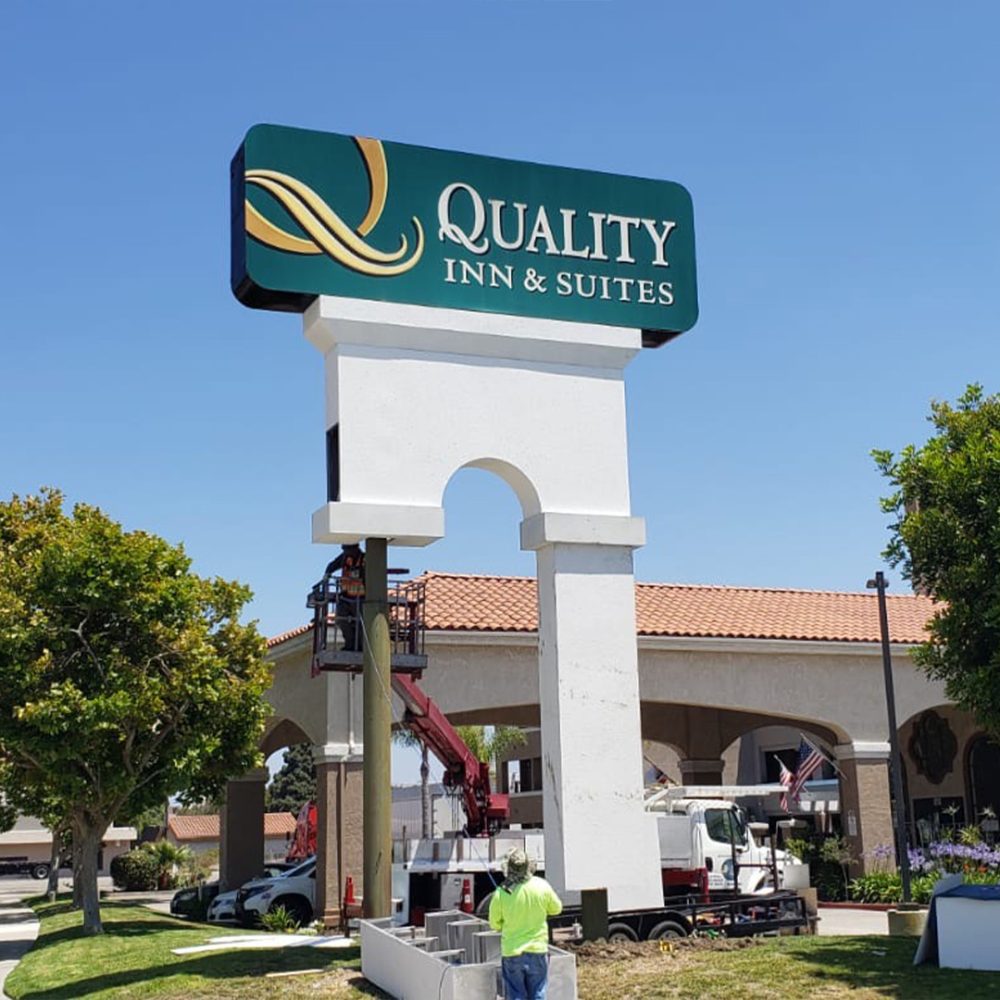
If you own or lease a commercial property in Southern California and you need a freestanding sign on the street, you have two main options: a monument sign or a pylon sign. They look different, cost different amounts, have different zoning rules, and serve very different business goals. Picking the wrong one is a five-figure mistake. This guide walks through the differences, real pricing, zoning realities in LA, and how to decide between them.
I have fabricated and installed both types across LA County, Orange County, and Riverside for over 20 years. The short version: monuments are about brand presence and permanence; pylons are about visibility and tenant identification at distance. Once you understand that, the decision gets easier.
Table of Contents
- What Each Sign Type Actually Is
- Height and Visibility Differences
- Zoning, Setbacks, and LA City Codes
- Cost Comparison: Monument vs Pylon
- Best Use Cases for Each
- Foundation Requirements
- Lighting Options
- Refresh vs Rebuild for Old Pylons
- Real Examples from LA, OC, and Riverside
- How to Decide
- Frequently Asked Questions
What Each Sign Type Actually Is
Monument Sign
A monument sign is a ground-level freestanding sign with a solid base. The base is typically masonry (brick, stone veneer, CMU), concrete, or a fabricated metal cabinet skinned to look like masonry. The sign face is often a single or double-sided aluminum cabinet with routed-out copy backed by polycarbonate, or individual push-through letters for a more premium look.
Monuments are usually 3 to 8 feet tall — always reading as "grounded" rather than "elevated." They convey permanence, quality, and intentional brand investment. The materials matter: real stone veneer on a monument at a law firm looks very different than a painted aluminum face on a strip mall monument, even if the shape is identical.
Pylon Sign (Pole Sign)
A pylon sign is an elevated sign mounted on one or two steel poles, typically 15 to 50 feet tall. The sign cabinet sits at the top, and the poles are usually wrapped in a decorative "pole cover" (painted aluminum or ACM panels) to hide the raw structure. Pylons may be single-tenant (one logo at the top) or multi-tenant (stacked panels for 2 to 8 tenants in a retail center).
Pylons are the signs you see from the 405, the 5, or the 91 freeway — they exist specifically because drivers at 55 mph need to identify a business 500 feet before the off-ramp. They are engineered for visibility at distance and speed.
Height and Visibility Differences
The height difference is not cosmetic — it fundamentally changes what the sign can do.
| Attribute | Monument Sign | Pylon Sign |
|---|---|---|
| Typical height | 3 to 8 feet | 15 to 50 feet |
| Sight line | Pedestrian and slow-traffic | Highway, arterial road, distance |
| Visibility distance | 50 to 300 feet | 500 to 2,000+ feet |
| Copy height | 4 to 10 inch characters | 12 to 36 inch characters |
| Speed context | Walking, 0-25 mph | 35-70 mph |
| Brand feel | Permanent, upscale, grounded | Commanding, commercial, retail-forward |
A 6-foot monument on a slower arterial like Wilshire through Hancock Park does the job beautifully — drivers are already slow, pedestrian traffic exists, and the scale fits the neighborhood. That same monument on the Artesia Freeway frontage in Cerritos is invisible at 65 mph. You need a pylon there.
Zoning, Setbacks, and LA City Codes
Every city in Southern California has a sign ordinance that limits what kind of freestanding sign you can install. These are the rules that drive most of the monument-versus-pylon decision. Here is how it plays out in cities we serve regularly:
- Los Angeles (LAMC Section 14.4): Pylon signs permitted in most commercial zones (C1, C2, CM, M1), typically capped at 35 feet in general commercial and higher on freeway-adjacent parcels. Monuments allowed nearly everywhere. Historic preservation overlay zones (HPOZ) restrict both types.
- Santa Monica: New pylon signs generally prohibited in most zones. Monuments allowed up to 6 feet in most commercial districts.
- Beverly Hills: Very restrictive. Pylons prohibited. Monuments require design review.
- Pasadena: Pylons prohibited in most commercial zones. Monuments allowed up to 8 feet with design review.
- Gardena, Torrance, Long Beach, Inglewood: Both types permitted in commercial zones with standard height limits (typically 25-35 feet for pylons, 6-8 feet for monuments).
- Anaheim, Santa Ana, Orange: Pylons permitted up to 30-40 feet depending on zone. Monuments widely allowed.
- Riverside County: Generally the most permissive — pylons up to 50+ feet on highway-adjacent commercial parcels, especially along the 91 and I-15 corridors.
Setback requirements matter too. Most cities require the sign to sit a minimum distance from the property line, the street curb, or driveway visibility triangles. A common rule in LA: freestanding signs must be at least 5 feet from the property line and out of the driveway sight triangle. Violating this during design means the plan check corrections cost you 3-6 weeks.
Before you spend money on design, pull the zoning code for your property address and check the sign ordinance. Or call us — we do this every week and can usually tell you within 24 hours what the parcel will allow. Our permits and engineering service handles the full research and filing.
Cost Comparison: Monument vs Pylon
Monument Sign Pricing (2026)
- Basic monument (4 ft tall, single tenant, painted aluminum cabinet with vinyl graphics): $5,000 - $8,000 installed
- Mid-range monument (6 ft tall, real stone or brick veneer base, push-through letters, LED illumination): $8,000 - $15,000 installed
- Premium monument (8 ft tall, multi-material — stone, metal, wood accents — custom letterforms, halo-lit or backlit): $15,000 - $25,000+ installed
Pylon Sign Pricing (2026)
- Small single-tenant pylon (15-20 ft, one cabinet, one pole): $15,000 - $25,000 installed
- Mid-range retail pylon (25-35 ft, 2-4 tenant panels, aluminum pole cover): $30,000 - $50,000 installed
- Large multi-tenant pylon (40-50 ft, 5-8 tenant panels, digital or electronic message board, ACM pole cover): $50,000 - $80,000+ installed
- Freeway-height pylon with electronic message center: $80,000 - $200,000+ installed
Pylons cost more because of the steel. The primary pole is typically 8 to 12 inch schedule 40 or 80 steel pipe, embedded 6 to 10 feet deep in a reinforced concrete foundation. The foundation alone can be $3,000 to $10,000. The crane required to set the pole adds $2,000 to $5,000. And the structural engineering for a 35+ foot pole in a seismic zone — which all of Southern California is — adds $1,000 to $3,000 to the engineering line.
Best Use Cases for Each
Monument Signs Are Best For
- Medical offices, dental, and professional services: A stone-base monument at a medical plaza signals stability and quality. Perfect for a single-tenant or 2-tenant building.
- Law firms, accounting, financial services: Monuments match the professional services aesthetic. Push-through halo-lit letters on a granite base reads as premium.
- HOA and residential community entry signs: The Village at Rolling Hills, The Oaks at Santa Clarita — these are almost always monument-style with subtle landscaping integration.
- Churches, schools, and municipal facilities: Monuments match the civic/institutional feel.
- Hotels and upscale restaurants in walkable districts: Downtown Culver City, old town Pasadena, Abbot Kinney — monuments fit the pedestrian-scale environment.
- Boutique retail and single-tenant restaurants: Where the building sits close to the road and frontage matters more than distance visibility.
Pylon Signs Are Best For
- Multi-tenant retail centers: A 35-foot pylon with 6 tenant panels is the workhorse sign of the American strip mall. It is still the single biggest driver of tenant foot traffic.
- Gas stations and convenience stores: Gas price signs need to be visible from the freeway approach. Pylons with electronic price displays are essentially mandatory for competitive fuel retail.
- Fast food and quick-service restaurants: Drive-by recognition at 45 mph is the whole business model. McDonald's, In-N-Out, Chick-fil-A — pylons sell the stop.
- Car dealerships and auto service: Large parcel, large inventory, large sign. Customers coming off the freeway need to see the brand from half a mile away.
- Hotels and motels on highway corridors: Travelers decide where to stop based on what they can see from the freeway sign. A Quality Inn or Holiday Inn pylon off I-5 or the 91 is pulling its weight every day.
- Industrial and warehouse tenants on commercial strips: When the building sits 200 feet back from the road, a pylon is the only way customers find you.
Foundation Requirements
Both sign types need engineered concrete foundations. The difference is scale.
Monument Foundations
A standard 6-foot monument sits on a pad footing, typically 4 feet by 6 feet, 3 to 4 feet deep, poured with 3,000 PSI concrete and reinforced with #4 rebar on 12-inch centers. The monument cabinet is anchored with embedded J-bolts cast into the top of the footing. Foundation work runs $1,500 to $5,000 depending on soil conditions, access, and size.
In areas with expansive clay soils (common in parts of Riverside, eastern LA County, and the Inland Empire), the footing may need to go deeper or require a geotechnical soils report. That can add $1,500 to $3,000.
Pylon Foundations
A pylon foundation is a different animal. A 35-foot single-pole pylon typically sits in a drilled concrete pier foundation — a 3 to 4 foot diameter shaft, 8 to 10 feet deep, heavily reinforced with vertical rebar and a concrete collar at the top. The primary steel pipe (8-12 inch schedule 40 or 80 depending on the height and cabinet size) is embedded in the concrete with proper cover.
Pylon foundations cost $3,000 to $10,000 depending on depth, diameter, and soil. Seismic design per ASCE 7 and CBC Chapter 16 is required for all of Southern California, and the structural engineer will size the foundation to resist both wind load and seismic forces.
Lighting Options
Both sign types are almost always illuminated — an unilluminated freestanding sign is hard to justify in a market like LA where competition is everywhere and half of business hours are after dark.
Monument Lighting
- Internal illumination: LED modules inside a polycarbonate-faced cabinet. Brightest option, highest visibility.
- Push-through letters with LED backlighting: Premium look. Letters appear to glow through the opaque cabinet face.
- Halo-lit reverse channel letters: Stainless or painted aluminum letters mounted on the monument face, with LEDs behind them creating a soft halo on the stone or metal.
- External ground-mount spotlights: In-grade LED up-lights washing the monument from below. Elegant, but less visible than internal illumination.
Pylon Lighting
- Internally illuminated cabinets: Standard. LED modules behind polycarbonate faces. Entire cabinet glows at night.
- Digital/LED message centers: Programmable electronic displays — common for gas prices, hotel vacancy, and promotional messaging. Adds $15,000 to $80,000+ depending on size and resolution.
- Channel letters mounted to pylon cabinet face: Premium retailers sometimes use halo-lit channel letters on pylons for a more sophisticated night appearance.
All modern sign illumination should be LED. If you are replacing an older fluorescent or neon-illuminated sign, plan to upgrade to LED at the same time — the payback on reduced energy and maintenance typically hits within 3 to 4 years. Our LED retrofit service handles conversions on existing cabinets.
Refresh vs Rebuild: Economics of an Old Pylon
A common scenario: you bought or leased a retail center with an existing pylon sign. The sign is 25 years old. Tenants have changed. The faces are yellowed and some are cracked. The question — rebuild or refresh?
When to Refresh
If the pole is structurally sound, the foundation is in good condition, the cabinet frame is not corroded, and the current height still matches what zoning allows, a refresh makes economic sense. Scope typically includes:
- New polycarbonate or acrylic tenant faces with updated graphics
- LED retrofit inside the cabinet (replacing fluorescent tubes and ballasts)
- Fresh paint on the pole cover and cabinet exterior
- New electrical disconnect and photocell if outdated
- Minor structural touch-ups (hardware replacement, seal repairs)
A full refresh typically costs 30 to 50% of a new-build price. A $45,000 rebuild might refresh for $15,000-$22,000, and the sign will perform as well for another 10-15 years.
When to Rebuild
Rebuild when:
- Visible rust or pitting on the pole at ground level (water intrusion usually destroys these from the inside out)
- Cabinet frame is deformed or the doors no longer seal
- Foundation has cracked, settled, or shifted
- Tenant mix has changed dramatically and the panel count is wrong
- Zoning has changed and you can now build taller or add features that would materially help the property
- The city is requiring code compliance upgrades that would exceed 50% of rebuild cost
Real Examples from LA, OC, and Riverside
A few project types we see repeatedly:
- Medical plaza in Torrance: 6-foot granite-veneer monument, push-through halo-lit aluminum letters, in-grade up-lights. $14,500 installed. Perfect for 3 professional tenants.
- Retail strip center in Gardena: 30-foot 5-tenant pylon, ACM pole cover, internally illuminated tenant panels with LED retrofit. Full rebuild $42,000. Refresh of the same structure would have been $18,000.
- Auto service on 91 Freeway in Riverside: 45-foot pylon with 24-inch tenant panels and LED message center. $85,000 installed. The business attributes 60% of drive-in customers to freeway visibility.
- Law firm in Long Beach: 5-foot stacked stone monument with halo-lit reverse channel letters. $12,800 installed. Sits 15 feet from curb on a quiet arterial — perfectly scaled.
- Hotel on I-5 in Anaheim: 38-foot pylon, single tenant, internally illuminated cabinet with a dynamic LED message strip for vacancy. $62,000 installed.
How to Decide: Monument or Pylon?
Here is the decision framework I use with clients. Answer these five questions in order:
- Does your city's zoning code allow a pylon at your address? If no, you are getting a monument. Decision made.
- How far from the building to the primary road? If the building is within 50 feet of the road and the primary traffic is slow (under 35 mph), a monument works. If 100+ feet back or primary traffic is 40+ mph, a pylon earns its cost.
- How many tenants? 1-2 tenants = monument is fine. 3+ tenants = pylon is probably better for tenant identification and retention.
- What is the brand positioning? Professional services, healthcare, and upscale retail lean monument. Quick-service retail, automotive, hospitality, and anything on a freeway leans pylon.
- What is the budget? Under $20,000 total and you are probably building a monument. $30,000+ and a pylon becomes feasible. Remember: pylon cost is partly a function of height — a 20-foot single-tenant pylon at $18,000 is a reasonable hybrid choice when zoning allows.
Frequently Asked Questions
What is the difference between a monument sign and a pylon sign?
A monument sign is a ground-level sign with a solid base, typically under 8 feet tall, built from masonry, stone, or metal. A pylon sign is an elevated sign mounted on one or more steel poles, usually 15-50 feet tall, designed for visibility from highways or across large parking lots.
How much does a monument sign cost vs a pylon sign?
Monument signs typically cost $5,000 to $25,000 installed. Pylon signs run $15,000 to $80,000 or more. A small single-tenant pylon at 20 feet runs around $15,000-$25,000. A 35-50 foot multi-tenant pylon with engineering and a crane install runs $40,000-$80,000+. Foundation work is a major cost driver for both.
Which cities in LA allow pylon signs?
Pylon signs are permitted in most unincorporated LA County areas and commercial zones in Gardena, Torrance, Long Beach, and Anaheim, subject to height and setback rules. Santa Monica, Beverly Hills, Pasadena, Manhattan Beach, and Culver City either ban new pylon signs or cap them at monument-scale heights.
When is it worth refreshing an old pylon instead of rebuilding?
If the pole, foundation, and structural frame are sound, a refresh is usually 30-50% of rebuild cost. Refresh scope includes new polycarbonate panels, tenant graphics, LED retrofit, and repainting the pole cover. Makes sense when the structure is under 15-20 years old and zoning still allows the current height.
Do monument signs need foundations?
Yes. Monument signs require engineered concrete foundations per California Building Code — typically a reinforced pad footing with rebar, sized for wind load and soil bearing. A standard 6-foot monument foundation is 3-4 feet deep and 4-6 feet square. Foundation work usually adds $1,500-$5,000 to the project.
Next Steps
If you are trying to decide between a monument and a pylon for your property — or figure out what your city's zoning will actually allow — we can help. Request a free quote or call us at (323) 830-6789. We will pull the sign code for your address, sketch design options, and give you realistic pricing for both approaches so you can make the right call. For related reading, see our guide to sign permits in Los Angeles, and our service pages for monument signs and pylon signs have detailed spec options and examples.