

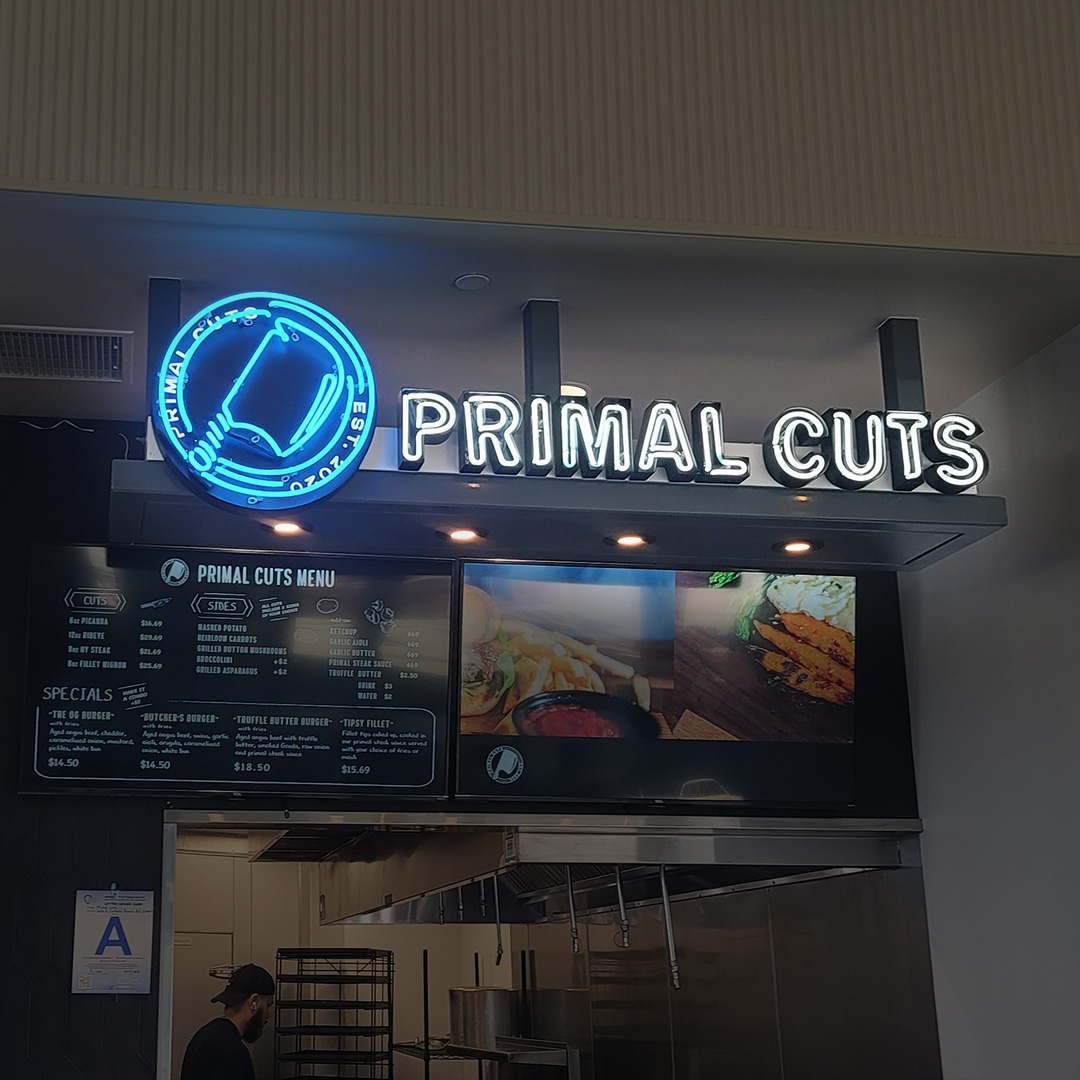
If you are opening a business in Los Angeles and trying to budget for your storefront sign, you are about to get very different numbers from very different companies. One quote says $2,200. Another says $11,000. Both claim to be channel letters. Who is right? Usually, both — they are just quoting completely different products. This guide walks through what a channel letter sign actually costs in LA in 2026, broken down the way a 20-year industry veteran would explain it to you over coffee.
I have quoted, fabricated, and installed thousands of channel letter sets across LA County, Orange County, and Riverside. I have also seen a lot of business owners get burned — either by overpaying for nothing special, or saving $1,500 upfront and spending $6,000 fixing it two years later. The goal of this article is to give you honest numbers, a framework for reading a sign quote, and the knowledge to know when to spend more and when to hold the line.
Table of Contents
- The Three Pricing Tiers (Basic, Mid, Premium)
- What Actually Drives the Cost
- Permits & Engineering in LA
- Install Crew Costs: Crane vs Ladder
- Why Warranty Length Matters
- Hidden Costs Nobody Warns You About
- Sample Line-Item Cost Breakdown
- What NOT to Cheap Out On
- How to Read a Sign Quote Line by Line
- When to Spend More vs When to Save
- Frequently Asked Questions
The Three Pricing Tiers for Channel Letter Signs in LA
Channel letter pricing in Los Angeles falls into three general tiers in 2026. These are the numbers I quote every week, based on in-house fabrication in Gardena with UL Listed components and a real warranty. Cheaper than these numbers usually means imported letters, off-brand LEDs, or both.
Tier 1: Basic ($1,500 - $3,000)
This tier is for small businesses on tight budgets: a single short word (3 to 6 characters), letters 12 to 18 inches tall, a single raceway, standard white or single-color acrylic faces, and front-lit illumination with generic (but UL Listed) LED modules. Think: a cafe, a small retail shop, a tax office. Installation is typically ladder or scissor-lift mounted on a one-story facade. Permit not included.
At this tier, you should still insist on UL Listing, .063 aluminum returns, and a minimum 2-year LED warranty. If a company quotes you $1,100 with a 6-month warranty, they are using disposable components. Walk away.
Tier 2: Mid-Range ($3,000 - $8,000)
This is where most storefront signs in LA actually land. Letter heights of 18 to 24 inches, 6 to 12 characters, standard front-lit construction, Matthews paint finish on returns, GE Tetra or SloanLED modules, proper trim cap, UL Listed Class 2 power supply, and a 5-year LED warranty. Installation is from a scissor lift or small boom. This is what most restaurants, salons, medical offices, and franchise tenants pay.
In this tier you should start seeing options — halo-lit upgrade, colored trim cap, custom returns, and weatherproofed mounting hardware for stucco or EIFS walls.
Tier 3: Premium ($8,000 - $25,000+)
This is large, tall, or complex signage: 30 to 48 inch letters, 10+ characters, reverse-lit (halo) stainless steel construction, custom font development, multi-depth sculpted letters, or combination front/back lit. Think: a flagship restaurant, a corporate headquarters sign, an anchor tenant at a retail center on Ventura Blvd or in Downtown LA. Installation almost always requires a crane or 60+ foot boom, a traffic control plan, and sometimes after-hours work.
At this tier, you should expect 5 to 10 year comprehensive warranties, third-party structural engineering, and dedicated project management. Anything less than that and you are overpaying.
What Actually Drives the Cost of a Channel Letter Sign
Eight variables determine what your sign will cost. When you understand these, two different quotes stop being confusing and start being comparable.
Letter Height and Count
Every inch of letter height and every extra character adds material, LED modules, fabrication time, and weight. A 36-inch letter is not twice the cost of an 18-inch letter — it is roughly 3 to 4 times the cost because the face area quadruples and the return depth grows to 5 or 6 inches to house more LEDs.
Letter Depth (Returns)
Standard channel letters have 3- to 5-inch returns. Taller or halo-lit letters often need 4, 5, or 6-inch returns to get even light distribution. Deeper returns require more aluminum and more LEDs, and they add to the total cost.
Illumination Type
Front-lit is the baseline. Reverse-lit (halo) runs 15 to 25% more because of stainless steel faces, precise standoff mounting, and extra waterproofing. Combination front/back lit (dual illumination) can add 40 to 60%. Open-face neon runs 30 to 50% more than front-lit LED.
Mounting Method
Flush-mounted letters (each letter attached individually to the wall) look cleaner but cost more to install — more penetrations, more patching, more wire routing. Raceway-mounted letters (all letters attached to a painted aluminum backer) are faster and cheaper to install, and landlords sometimes require this to protect the facade.
Facade Material
Stucco and EIFS facades need longer anchors and sealant. Brick and block require masonry drilling. Metal panels need spacer clips. Concrete tilt-up walls may require engineered expansion anchors. Each adds labor hours.
Permit & Engineering Requirements
Every commercial sign in LA County needs a permit. Most need stamped structural engineering. Big ones need wind-load calcs. This is a real line item, not optional — covered below.
Location Difficulty
Installation on the 5th floor of a mid-rise on Wilshire Blvd is a different animal than a one-story in Gardena. Downtown LA installs often require nighttime work, traffic control permits from LADOT, and larger cranes. That can add $2,000 to $5,000 in install costs alone.
Brand and Design Complexity
A simple block-letter logo with 7 characters is easy to fabricate. A custom script font with connecting swashes, ornaments, or multi-layer depth is slow, expensive, and sometimes requires pattern-making by hand. Custom complexity can double labor costs.
Permits and Engineering in Los Angeles
LADBS (Los Angeles Department of Building and Safety) requires a permit for essentially every illuminated exterior sign in the City of LA. Unincorporated LA County areas and the 87 other cities in the county each have their own building departments with similar requirements. Permit and engineering costs in 2026 break down like this:
- LADBS sign permit fee: $300 to $600 for a standard wall sign
- LADBS electrical permit: $150 to $300
- Plan check (standard): $200 to $400; expedited add $300 to $600
- Structural engineering (wet-stamped by a California PE): $500 to $1,500
- Property owner authorization / landlord approval package: time only, but often a 1-3 week delay
- Historic or overlay districts (Downtown, Venice, Hollywood): add $500 to $2,000 for design review
Total permit and engineering budget in LA typically runs $800 to $2,500. Cities like Beverly Hills, Santa Monica, Pasadena, Manhattan Beach, and Culver City run on the higher end because of stricter design review and slower plan check timelines. Gardena, Torrance, Inglewood, and Long Beach are generally more reasonable.
If a sign company tells you "don't worry about the permit," run. An illegal sign gets red-tagged, fined, and sometimes forced to come down. It also voids your commercial insurance in the event of a fall. Always pull the permit correctly — the cost is real but small compared to the downside of not having one.
Install Crew Costs: Crane vs Ladder vs Boom
Installation is typically 15 to 25% of a total channel letter project cost, but that percentage can double when the site requires a crane or traffic control. Here is what each scenario typically costs in LA in 2026:
- Ladder/scissor lift install (1-story, easy access): $800 to $1,500 labor for a 2-person crew in a half day
- Boom lift (up to 40-50 feet): $1,200 to $2,500 including rental, half to full day
- Crane day (60-120 feet, certified operator): $1,800 to $3,500; add $400 to $900 if a ground spotter and traffic cones are required
- LADOT street-use permit (if lift or crane blocks a lane): $150 to $500 plus 2-3 week lead time
- Night install (if daytime closures aren't allowed): 30-50% labor premium
The biggest install surprise is usually facade repair. If the old sign left stucco holes, rusted raceway mounts, or painted-over electrical penetrations, those have to be patched and repainted before the new sign goes up. Budget $400 to $1,500 for facade prep if you are replacing an old sign.
Why Warranty Length Is Really a Quality Signal
LED channel letters should last 10+ years without meaningful degradation. The warranty a sign company offers tells you exactly how much they trust their own components.
A 1-year warranty means: "We assume this will fail, so we are only covering the first year." A 5-year warranty means: "We use GE Tetra or SloanLED modules and UL Listed transformers, and we have data on how they age." A 10-year warranty is rare and usually limited to specific premium component lines.
When comparing two quotes that are $2,000 apart, the warranty length often explains the delta. A $4,500 quote with a 5-year warranty is often better long-term value than a $3,800 quote with a 1-year warranty — because year 2 LED failures on the cheap sign will cost $300 to $800 per service call.
Hidden Costs Nobody Warns You About
These are the line items that show up after you sign the contract if the quote wasn't comprehensive:
- Electrical sub-feed: If the building does not have a dedicated 120V circuit at the sign location, running new conduit and adding a breaker costs $600 to $2,500 depending on distance and whether the panel has capacity.
- Timer or photocell: Most LA cities require an automatic shut-off so the sign turns off overnight. A photocell is $80 installed; a timer is $150 to $300.
- Landlord deposits and approvals: Some landlords require a $500 to $2,500 refundable deposit against facade damage, plus sign-off on sign drawings. Plan 2 to 4 weeks for landlord review.
- As-builts and closeout documents: After install, some landlords or corporate tenants require as-built drawings. Budget $200 to $500 if not included.
- Decommissioning the old sign: Removing and disposing of an old cabinet or channel letter set typically runs $400 to $1,500 depending on size and facade repair needs.
- Rush or after-hours work: 20 to 50% premium for expedited fabrication or nighttime install.
- Sales tax: California sales tax applies to the materials portion (not installation labor). Budget 9 to 10% on the fabrication line.
Sample Line-Item Breakdown: $6,700 Mid-Range Sign
Here is a typical 2026 quote for a mid-range channel letter sign in Los Angeles — 8 characters, 24-inch letters, front-lit, installed on a one-story stucco facade in a strip mall along Sepulveda Blvd. These are the real line items I use.
| Line Item | Detail | Cost |
|---|---|---|
| Design & renderings | 2 rounds of revisions, scaled mock-up | $450 |
| Fabrication — letters | 8 letters, .063 aluminum, 24" tall, 5" returns, white acrylic face, Matthews paint | $2,850 |
| GE Tetra LED modules | UL Listed, 5-year warranty | $480 |
| UL Listed Class 2 power supply | Weatherproof enclosure, proper wire gauge | $220 |
| Raceway (painted aluminum) | Matches building trim color | $350 |
| Permit + electrical permit | LADBS standard wall sign | $425 |
| Structural engineering | California PE stamp, wind-load calcs | $650 |
| Installation | 2-person crew, scissor lift, half day | $1,150 |
| Final inspection & closeout | LADBS inspection coordination | $125 |
| Project Total | $6,700 |
This is the kind of transparency you should expect. If your quote just says "Channel letters - $6,700" with no breakdown, ask for one. Any reputable shop will provide it.
What NOT to Cheap Out On
After 20 years in this industry, I can tell you exactly which three items cause 90% of the sign failures I get called to repair.
LED Modules
UL Listed, commercial-grade modules from GE (Tetra), SloanLED, or Principal are the standard. They cost $55 to $80 per 10-foot string. Off-brand LEDs from unknown manufacturers cost $15 to $30 per string — and fail in 2 to 3 years, often in ugly patterns (half a letter goes dark, or color shifts pink). Replacing LEDs means re-opening the letters, which costs $150 to $400 per letter in service calls. Pay for the good ones up front.
Transformers and Power Supplies
Every channel letter set needs a UL Listed, Class 2, low-voltage power supply (typically 12V DC). Non-UL transformers are a fire hazard, will fail LADBS inspection, and will void your commercial insurance after a claim. Never accept a sign without UL Listed power components.
Anchoring and Mounting Hardware
The #1 reason channel letters fall off buildings is under-spec anchors. Stucco is not structural — the anchor must tie into the framing or sheathing behind it. Proper installation uses toggle bolts, Tapcons into block, or sheet-metal screws into steel studs based on the substrate. Cheap installs use plastic drywall anchors. Guess which ones end up on the sidewalk during a windstorm.
How to Read a Sign Quote Line by Line
A legitimate channel letter quote should include all of these elements. If any are missing, ask the question:
- Letter specs: height, depth, count, font, color
- Aluminum gauge (should be .063 for returns, not .040)
- Face material (acrylic thickness, brand, color code)
- LED brand and model (should be UL Listed — GE, SloanLED, Principal)
- Paint system (Matthews automotive paint is the industry standard)
- Power supply brand and UL Listing
- Mounting method (flush, raceway, standoffs)
- Permit and engineering scope — who files and pays
- Install crew size, lift type, and time estimate
- Warranty length in years (LEDs, paint, workmanship)
- Payment schedule (typical: 50% to start, balance on install)
- Lead time from deposit to install
When to Spend More vs When to Save
Spend More When:
- You own the building or have a long lease (5+ years) — quality pays back over time
- The facade is visible from a highway or major arterial — signs in bright daylight need deeper returns, more LEDs, and premium acrylic
- You operate at night — illumination quality is make-or-break, and the delta between premium and generic LEDs is very visible after dark
- Your brand is in professional services, luxury retail, or hospitality — the sign is part of the customer's first impression
Save When:
- You have a short-term lease (2 years or less) with no extension plans
- The sign is secondary signage — a side door, a secondary facade, or a blade sign — where a simple cabinet sign or light box often does the job
- You are in a location with very limited nighttime traffic
- A landlord is paying for it as a tenant improvement
Even when you save, never compromise on LEDs, transformers, or anchoring. You can save on letter size, count, or illumination type. You cannot save on the parts that determine whether the sign stays lit and stays on the wall.
Frequently Asked Questions
How much does a channel letter sign cost in Los Angeles in 2026?
A typical channel letter sign in LA costs between $1,500 and $25,000. Small basic sets (3-6 characters, 12-18" tall) fall in the $1,500-$3,000 range. Mid-range sets run $3,000-$8,000. Premium or large sets land between $8,000 and $25,000 or more. Permits, engineering, and crane-assisted installation are commonly added on top.
How much does a sign permit cost in Los Angeles?
LADBS sign permit fees typically run $300 to $900 for a standard wall-mounted channel letter set. Add structural engineering at $500 to $1,500, and expedited plan check if needed. Total permit and engineering cost usually falls between $800 and $2,500. Beverly Hills, Pasadena, and Santa Monica run higher.
Why do two sign companies quote such different prices?
Channel letter quotes vary because there is no standard spec. One shop may quote .040 aluminum, generic LEDs, and a 1-year warranty. Another may quote .063 aluminum, UL Listed GE Tetra LEDs, Matthews paint, and a 5-year warranty. The lower price is not a better deal — it is a different product. Compare line items.
Do I need a crane to install channel letters?
A crane is required when letters mount above roughly 50 feet, or when boom or ladder access is not safe or when the facade does not allow safe ladder or boom access. A boom-lift day costs $600-$1,200; a crane day runs $1,800-$3,500 and sometimes requires an LADOT street-use permit. Low single-story facades are usually installed from a scissor lift.
What should I NOT cheap out on with a channel letter sign?
Do not cheap out on LED modules, transformers, or anchoring. Off-brand LEDs dim unevenly and fail within 2-3 years. Non-UL transformers can fail inspection or cause fires. Under-spec anchors in stucco or EIFS are the #1 cause of signs falling off buildings. Pay for UL Listed components, a real 5-year warranty, and proper engineering.
Next Steps
If you are ready to get a real, itemized quote for your Los Angeles channel letter sign, request a free estimate or call us at (323) 830-6789. We fabricate every set in-house in Gardena, handle the full permit package, and install with our own crews — no subcontractors, no middlemen. For related reading, our complete guide to channel letters covers the five types and their use cases in detail, and our front-lit channel letter service page has examples and spec options.